
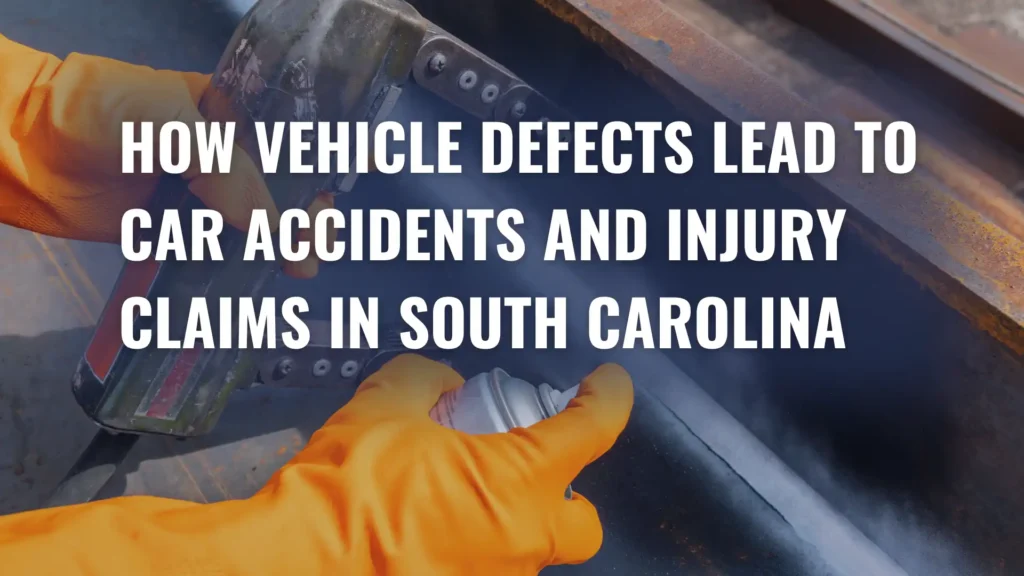
When a vehicle defect causes a crash, the harm goes beyond car damage. Serious injuries, huge medical bills, and lost income can turn your life upside down. You need to know your rights.
At Crantford Meehan, we help South Carolina residents get money when defective vehicles cause injuries. If a vehicle defect caused your crash, contact our personal injury attorneys for a free consultation.
What Are Vehicle Defects?
Vehicle defects are flaws in a car’s design or build that make it unsafe to drive. These flaws exist no matter how careful the driver is. A defective part can fail without warning, leaving the driver unable to stop a crash.
There are three main types:
- Manufacturing defects — Errors during production cause a part or vehicle to fall short of its design specs. One mistake on the assembly line can put thousands of unsafe cars on the road.
- Design defects — The vehicle’s design itself creates a safety risk, even if the car is built exactly as planned. These cases require proof that a safer design existed and was doable.
- Failure to warn — The maker knew about a risk but did not tell buyers. This includes missing warnings and poor instructions.
Common defective parts that cause crashes include:
- Brakes that fail without warning
- Airbags that deploy at the wrong time or not at all
- Steering that stops responding
- Tires prone to blowouts
- Seat belts that do not hold riders in place
The National Highway Traffic Safety Administration (NHTSA) tracks defects and issues recalls. But recalls do not always reach every owner. Some owners never get the repair done. When a defective car causes a crash, proving the defect — not driver error — caused it is the key to your claim.
Types of Defects That Cause Crashes
Manufacturing Defects
A faulty weld, wrong part, or bad material can make a car unsafe. These defects often affect a small batch of vehicles from one production run. These cases tend to be easier to prove because the car failed to meet its own design specs.
Our attorneys work with accident reconstruction experts to study damage patterns and find whether the defect caused the crash.
Design Defects
A design defect means the car’s blueprint itself is flawed. Even a car built exactly to spec can be unsafe if the design is bad. For example, a fuel tank placed where it ruptures on impact is a design defect.
These defects cause crashes in several ways:
- Brake failures — Stop drivers from braking, causing rear-end crashes
- Steering defects — Make the car hard or impossible to control
- Tire failures — Cause blowouts that flip or spin vehicles, especially trucks and SUVs
- Airbag flaws — Fail to deploy in a crash or go off on their own
How Defects Lead to Serious Injuries
Defect-caused crashes often produce worse injuries than normal accidents. A brake failure at 60 mph creates a far more violent impact than a typical fender bender. The forces are greater, and the trauma is worse.
Common injuries include:
- Traumatic brain injuries
- Spinal cord injuries and paralysis
- Multiple fractures
- Internal organ damage
- Severe cuts and permanent scars
Many victims face chronic pain, reduced mobility, and permanent disability. These injuries often require long-term medical care.
Medical costs add up fast — ER visits, surgery, hospital stays, rehab, and ongoing care. Many victims cannot return to work right away, or at all. Understanding how to calculate lost wages is key to getting full payment.
Proving Liability in Vehicle Defect Cases
To win a defect claim, you must show three things:
- The vehicle had a defect (manufacturing, design, or failure to warn)
- The defect made the car unreasonably dangerous
- The defect caused your crash and injuries
South Carolina product liability law holds makers, parts suppliers, and dealers responsible for defective products. Unlike negligence claims, you do not have to prove the maker was careless. You only have to prove the product was defective and dangerous. Understanding the difference between negligence and product liability matters for your case.
Who Can Be Held Liable
Several parties may owe you money:
- The vehicle maker — Bears primary blame for design and manufacturing defects
- Parts suppliers — Liable if they made the defective part
- Dealers — May share blame if they knew about the defect
- Mechanics — Liable if their work created or missed the defect
In many cases, multiple defendants share blame. Our attorneys find every liable party to get you the most money.
What You Must Prove
You must prove your case by a “preponderance of evidence.” This means it is more likely than not that the defect caused your injuries. This is a lower bar than criminal cases, which need proof beyond a reasonable doubt.
Evidence You Need
Building a defect case requires strong evidence:
- The damaged vehicle — Forensic exams can show whether the defect or driver error caused the crash
- Maintenance records — Proof the car was well maintained rules out poor upkeep as a cause
- Recall notices and NHTSA complaints — Show the maker knew about the defect
- Expert testimony — Engineers and crash experts explain how the defect caused the wreck
- Medical records — Link your injuries to the crash
Do not let the car be repaired until your lawyer and an expert have looked at it. Repairs can destroy proof of the defect. Our attorneys guide you through evidence preservation to protect your claim.
Negligence vs. Product Liability
Negligence claims require proving the defendant was careless. Product liability claims require proving the product was defective and dangerous — even if the maker used reasonable care. South Carolina courts allow all three types of product liability claims. Understanding how to prove fault is key to your case.
Vehicle Recalls and Your Legal Rights
NHTSA maintains a database of vehicle recalls. A recall means the maker admitted a defect exists and poses a danger. If your car was under recall at the time of the crash, that proof is strong for your claim.
When NHTSA finds a defect, makers must notify owners and fix the problem for free. But not all owners get the notice. Many who do never get the repair.
Recalls help your case in several ways:
- They prove the defect existed
- They show the maker knew about it
- The repair procedure proves a safer option existed
- They create a timeline of when the maker found out
Check NHTSA’s recall database for your vehicle. If you did not get the recall repair done, that does not kill your claim. The defect still caused the crash. An uncompleted recall can actually help your case by showing the maker knew and failed to ensure the fix was done.
Steps to Take After a Vehicle Defect Crash

Your first priority is safety and medical care. Move to a safe spot. Call 911 if anyone is hurt. See a doctor even if you feel fine — some injuries show up late. Knowing what to do after a crash protects your rights.
Document the Defect
Before the car is fixed or scrapped:
- Take photos and videos of the damage
- Focus on the area where the defect occurred (brakes, tires, steering)
- Note the car’s condition, mileage, and service history
Learn how to take accident scene photos that will help your case.
Preserve Evidence
- Do not let anyone repair the car until your lawyer and an expert have seen it
- Ask your insurer to preserve the vehicle
- Gather all maintenance records
- Collect any recall notices you received
- Get the full service history from the dealer
Report to NHTSA
File a complaint with NHTSA’s Office of Defects Investigation. This creates an official record. If many people report the same defect, NHTSA may launch a probe — which helps your case.
Get Medical Care
Get a full medical exam and keep records of all treatment — ER visits, hospital stays, surgery, physical therapy, and follow-ups. Document every cost. Knowing how to track medical expenses helps you get full payment.
Call a Lawyer
Vehicle defect cases are complex. An attorney can:
- Investigate whether a defect caused your crash
- Find all liable parties
- Pursue full payment on your behalf
Early action protects your evidence. Contact a car accident lawyer right away.
How Crantford Meehan Can Help
At Crantford Meehan, we know how to handle vehicle defect cases. We have recovered settlements that cover medical bills, lost wages, and pain and suffering.
Our Attorneys
Both partners — William C. Crantford and Jerry A. Meehan Jr. — are graduates of Gerry Spence’s Trial Lawyers College. Both hold AV Preeminent ratings from Martindale-Hubbell, the highest peer rating for legal skill and ethics.
Our results in vehicle cases include:
- $2.35 million settlement — Family hurt in a tractor-trailer crash on I-26 in Berkeley County
- $1 million recovery — Clients struck by an 18-wheeler near Summerville
See our case results and client testimonials for more.
Our Investigation Process
We dig into every angle:
- Retain engineers and crash reconstruction experts to examine your car
- Analyze damage patterns to find whether the defect or driver error caused the wreck
- Obtain maintenance records and service history
- Research NHTSA recalls and complaints for your vehicle
Working With Experts
Expert testimony is key in defect cases. We work with engineers, crash reconstruction specialists, and medical professionals who can explain the defect, its role in the crash, and how it harmed you.
Negotiating and Litigating
We present the evidence to makers, suppliers, and insurers and push for fair payment. When a fair deal cannot be reached, we take cases to trial. We are not afraid of large corporations with big legal teams. We have litigated complex personal injury cases against major makers.
Contingency Fee Basis
You pay nothing upfront. We only get paid if we win your case. This means you can pursue your claim with zero financial risk.
Frequently Asked Questions
What is a vehicle defect?
A vehicle defect is any flaw in a car’s design, build, or safety warnings that makes it unsafe to drive. There are three types:
- Manufacturing defects — Production errors cause a part to fall short of its design
- Design defects — The design itself creates an unreasonable risk, even if the car is built correctly
- Failure to warn — The maker did not tell buyers about known dangers
Can I sue a car maker for a defect-caused crash?
Yes. Under South Carolina product liability law, you can sue makers, parts suppliers, and dealers. You do not need to prove they were careless — only that the product was defective and dangerous, and that the defect caused your crash. Our personal injury attorneys can review your case.
How do I prove a vehicle defect caused my crash?
You need several types of evidence:
- Forensic exam of the vehicle
- Expert testimony from engineers and crash specialists
- Maintenance records showing the car was well kept
- Recall notices and NHTSA complaints
- Medical records linking your injuries to the crash
Our attorneys know how to gather and present this proof.
What damages can I recover?
You may recover:
- Medical expenses (past and future)
- Lost wages and reduced earning power
- Pain and suffering
- Property damage
- Punitive damages in cases of extreme misconduct
Understanding how pain and suffering damages are calculated helps you know what your case is worth.
How long do I have to file a claim?
South Carolina gives you three years from the date of the crash to file a personal injury lawsuit. But some defect cases have different timelines based on when the defect was found. Talk to a lawyer soon to protect your rights.
What if my car was recalled but I did not get it fixed?
An uncompleted recall does not kill your claim. It actually helps your case. It shows the maker knew about the defect. The fact that you did not get the repair done does not mean you caused the crash — the defect did.
Do I need a lawyer for a vehicle defect claim?
Yes. Makers have massive legal teams. You need experienced personal injury attorneys who can investigate the defect, hire experts, and fight for full payment. Early action protects your rights.
Contact Crantford Meehan for Your Vehicle Defect Claim
If a vehicle defect caused your crash and injuries, you deserve full payment. Crantford Meehan represents South Carolina residents hurt by defective vehicles. We investigate, work with experts, and fight for fair results.
Contact us today for a free consultation. Call (843) 832-1120 or visit our website. We serve South Carolina from our Charleston, Summerville, and Florence offices.

-

February 23, 2026
Who Is Liable in a Rental Car Accident in Charleston? -
February 20, 2026
The Role of Trucking Company Negligence in Accident Claims in Charleston -
February 16, 2026
What to Do After a Car Accident in South Carolina: A Step-by-Step Guide -
Fill out the form below
NATIONALLY RECOGNIZED LAW FIRM


REQUEST YOUR FREE CONSULTATION

GET THE HELP YOU NEED
Fill out the form below to get in touch with us!